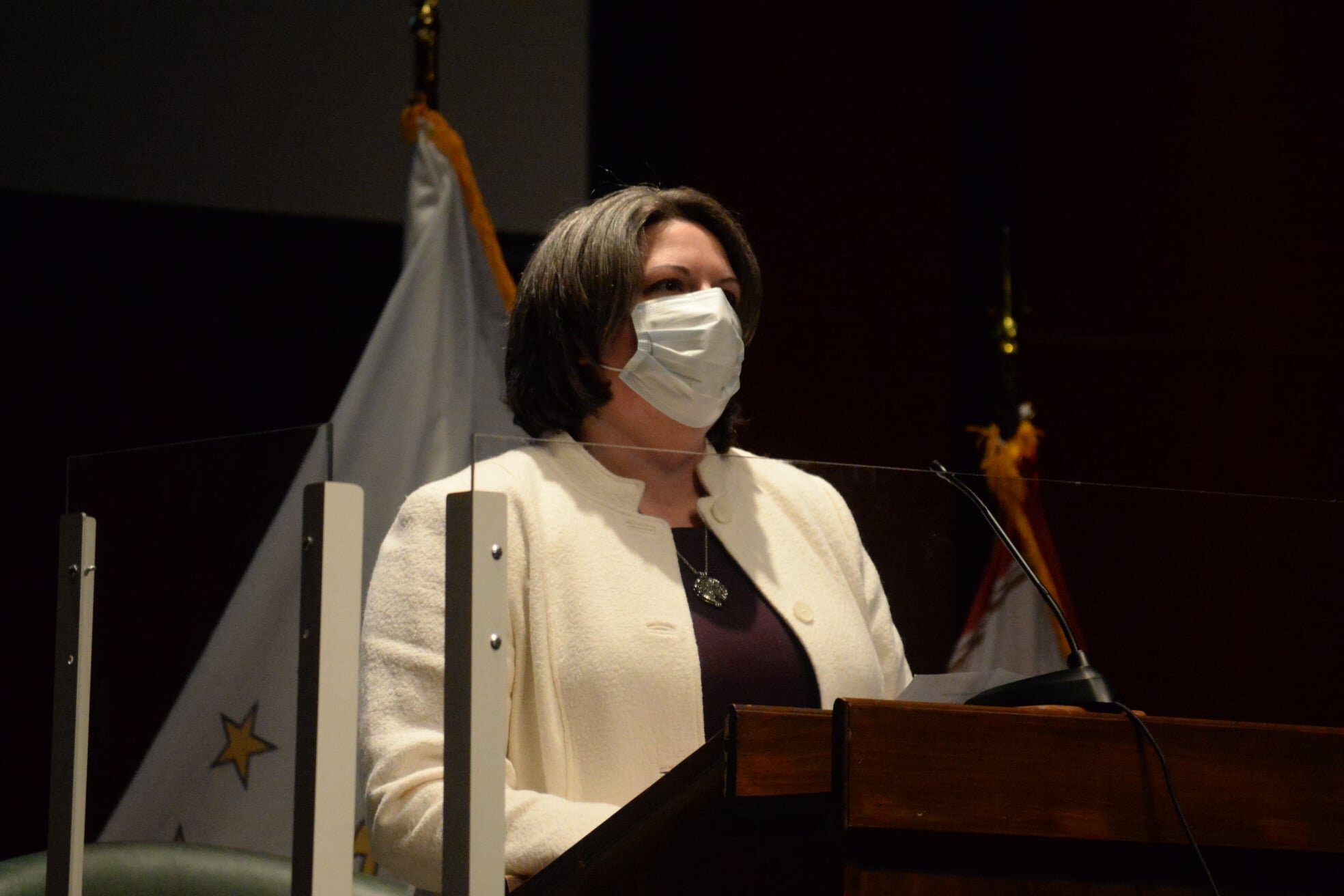
Landmark climate legislation signed into law

State Sen. Dawn Euer, D-Newport, the bill’s lead sponsor in the Senate, reminded the crowd that Bowen’s Wharf was under water in 2012 in the wake of Superstorm Sandy, to illustrate what’s at stake for coastal communities. The average sea level of Narragansett Bay has risen six inches in the last 30 years and is expected to accelerate, speakers said.

For more than a decade, versions of this bill have been introduced into the General Assembly, she said. In 2014, former State Sen. William J. Conley Jr., D-East Providence, successfully sponsored the Resilience RI bill “that set the framework that led to today’s victory,” she said.

“That history is important to understand and recognize that while the change we want to see does not happen overnight, progress continues to happen day by day and year by year,” Euer said. “It happens when we come together and work for a cause.”

Carson, Euer Introduce State Climate Bill

“The Ocean State is particularly vulnerable to the effects of sea rise caused by warming temperatures,” she said. “Communities like mine in Newport are already inundated more regularly and severely by storm surges, and face loss of public and private property, historic sites and businesses. Climate change isn’t something that will happen at some nebulous future time. It is wreaking havoc on our communities right now. As a state with so much to lose, we cannot afford and have no excuse to be anything but totally committed to negating our carbon emissions. This is, without question, our battle and our responsibility.”

Euer said she sees the positive economic impact that comes with fighting climate change. During her Senate floor speech, she pointed out that Commerce Rhode Island has said that the offshore wind sector will create between 20,000 and 35,000 jobs along the East Coast by 2028.

“Rhode Island has been on the leading edge of offshore wind in the United States, and is also at the forefront of other renewable generation and efficiency programs,” she said. “With Washington now also shifting toward support for the important work of adopting clean energy solutions, we have everything we need to do our part to slam the brakes on carbon pollution while revolutionizing our economy at the same time.

“Rhode Island was the birthplace of the Industrial Revolution. We can seize this moment and become America’s leader in the new green economy, creating plentiful green jobs that support families and a clean environment,” said Euer.

RI Senate OKs climate bill that puts teeth into greenhouse-gas controls

The effort to make reductions of planet-warming carbon dioxide emissions mandatory in Rhode Island took a big step forward Tuesday with Senate approval of the Act on Climate bill.

The landmark legislation that environmental groups, public-health experts and citizen advocates say is necessary for the state to do more to fight climate change won passage in a 33-to-4 vote. 

"Climate change is real, and its impacts will continue to be devastating if we don’t take action. This is without question our battle and our responsibility,” said Sen. Dawn Euer, the Newport Democrat who introduced the legislation. “This bill is critical to make sure we take the climate crisis seriously and take action as a state.”

Senate approves legislation sponsored by Senator Euer to update climate-emission reduction goals and to make them enforceable

The Senate today approved legislation sponsored by Senate Environment and Agriculture Chairwoman Dawn Euer to update Rhode Island’s climate-emission reduction goals and to make them enforceable.

The 2021 Act on Climate (2021-S 0078A) would make the state’s climate goals outlined in the Resilient Rhode Island Act of 2014 more ambitious and updated with current science. Under the bill, the state would develop a plan to reduce all climate emissions from transportation, buildings and heating, and electricity used economywide in the state to 10 percent below 1990 levels this year, 45 percent below 1990 levels by 2030, 80 percent below 1990 levels by 2040 and net-zero by 2050.

The sponsor says the climate crisis poses too grave a threat to the earth and to Rhode Island in particular to treat climate emissions reduction as an aspiration rather than an obligation.

Senator Euer bill bans evictions during states of emergency, establishes eviction-diversion program

The Senate Judiciary Committee will hold a hearing today on legislation sponsored by Sen. Dawn Euer to impose a moratorium on nonessential residential evictions and mortgage foreclosures during a state of emergency and establish an eviction-diversion program to resolve landlord-tenant eviction disputes.

“There should be no risk of more people becoming homeless during a state of emergency. Having housing is the Number 1 determinant of individuals’ health, safety, ability to stay employed and afford the essentials. Allowing evictions to proceed in times of widespread crisis would exponentially multiply the costs of those challenges, both in terms of dollars and in human harm,” said Senator Euer (D-Dist. 13, Newport, Jamestown).

Neronha, Euer want to alter drug possession laws

Two elected officials with local ties are backing a bill in the state legislature that would downgrade the possession of certain drugs from a felony to a misdemeanor.

The bill, which is supported by state Attorney General Peter Neronha, would amend the Uniform Controlled Substances Act to reclassify simple possession of 10 grams or less as a two-year misdemeanor. This includes cocaine, heroin, PCP, LSD and methamphetamine. Marijuana already was decriminalized in Rhode Island in 2013, and medical marijuana has been legal since 2006. State Sen. Dawn Euer, a Democrat who represents Newport and Jamestown, is co-sponsoring the bill.

By defelonizing certain levels of drug use and possession, the hope is people will be able to seek addiction treatment rather than ending up in a cycle of drug use and arrests, according to Senate Majority Leader Michael McCaffrey, a Warwick Democrat who introduced the bill. He said it is difficult for felons to find work after prison, and this bill may reduce that issue for people trying to get back on track. He cited success with defelonizing drugs in California and Utah.

Entire Aquidneck Island delegation opposes planned expansion of fracked gas

The entirety of the Aquidneck Island delegation to the Rhode Island General Assembly sent a letter to National Grid advocating for the non-infrastructure solution to the island’s fracked gas capacity issues. In the letter, Senators Dawn EuerLouis DiPalma and James Seveney, and Representatives Lauren CarsonTerri CortvriendSusan DonovanMarvin Abney and Deborah Ruggiero argue that the future of development on Aquidneck Island does not depend on the expansion of fracked gas infrastructure.

Aquidneck Island municipalities can continue their development plans without increasing reliance on gas. New buildings can easily be designed to meet their energy needs with a combination of efficiency measures and modern green technologies,” write the legislators, adding, “Weatherization and electrification are far more cost-effective solutions for ratepayers than an expansion of gas infrastructure.

In a report, National Grid had identified a future gas capacity issue, based on their projection of fracked gas demand on the island and provided a cost analysis of various options to address this demand. The most expensive option, according to National Grid, was to reduce dependency on fossil fuel through a process of electrification of heating and weatherization of homes. Environmentalists in Rhode Island cried foul, pointing out that National Grid had failed to account for the economic benefits of reducing the use of fossil fuels. The company had seemingly produced the report based on their bottom line, not on the health and safety of the communities they purportedly serve.

National Grid should be working with customers to reduce gas demand in our communities,” write the legislators. “Gas and associated infrastructure have well-documented safety and health concerns. Combustion and methane leaks will continue to contribute to local safety risks, air pollution, and climate change for decades. Even “decarbonized fuels” like renewable natural gas or hydrogen substitutes carry the same risks to public health and safety as geological natural gas. In sum – the continued use of these fuels compromises the health and safety of residents; expanding the infrastructure for their continued use will be a cost passed on to ratepayers at a time when so many are struggling.

Recently, National Grid was granted an exception to oversight by the Energy Facilities Siting Board (EFSB) for the erection of temporary fracked gas facilities to deal with the capacity issues caused by the companies own negligence. The legislators were adamant that any future expansion of fracked gas infrastructure on Aquidneck Island must be brought before and approved by the EFSB, writing, that the EFSB “is the proper regulatory authority to vet National Grid’s proposals to ensure a proper balance between the consumer costs, adverse environmental impacts, health and safety of Rhode Island’s citizens, and demonstrated need of the facility to meet the energy needs of the community.”